
Concerning spoilers: I avoided mentioning story plots in this review, but I had to address some concepts you may not want to know, which were revealed in the trailers for this movie.
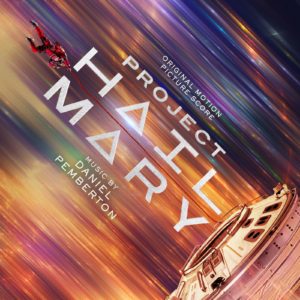
I have been looking forward to seeing Project Hail Mary after seeing its first trailer. In a world where Hollywood blockbusters are dominated by sequels, nostalgia or other ties to franchises, it felt like we would finally get a science fiction movie with a new, original story. The movie is about a biologist who finds himself alone in a spaceship far from Earth, on a mission to save his planet. The film is based on a book by Andy Weir, who also wrote The Martian, a movie from that book that I liked very much. The directors of this film, Phil Lord and Christopher Miller, are also responsible for the outstanding Spider-Verse movies, and the music for Project Hail Mary would be written by a longtime collaborator of theirs, Daniel Pemberton.
Especially the fact that Pemberton composed the score excited me the most, because he is capable of delivering magnificent, untraditional, innovative scores. After leaving the movie theater and seeing one of the best films I have seen in recent years, I knew that I had to do a deep dive exploring the music Pemberton has written. Luckily for me, I came across this fantastic interview, in which Jon Burlingame spoke with Pemberton about the movie. In their conversation, they discussed in great depth the sounds and other musical ideas Pemberton had created for the film, which confirmed some of my impressions about the music and also informed me about subtle details I might not have found. I highly recommend listening to that interview.
There are two major aspects I want to highlight for this soundtrack, and both of them are already showcased in the first track, “Ryland Grace, Cognition Assessment.” With the words ‘Hail’ and ‘Mary’ in the title, it was unsurprising that Pemberton opted for some gorgeous choir writing. Every time something happens related to humanity, you can hear these stunning choir pieces, as in “Humanity” and “You Were Loved (Burial),” for example.
The other aspect of the film music is the soundscape. In the music, you can occasionally hear the orchestra in the background, but as Pemberton said, it was just an extra instrument for him. For this score, Pemberton used a wide range of sounds as instruments, including wood blocks, steel pans, tapping water-filled bowls, glass instruments and squeaky taps. Another fantastic inclusion in the music is the use of processed human voices on the tracks featuring the mysterious alien the biologist met in space. “Learning to Communicate” is an excellent example of how to use these processed voices effectively.
All these elements combined, result in an outstanding score, blending this original ‘orchestra’ of weird instruments with human voices. It makes the entire album worthy of your attention. In addition to the choral parts, there are a few other highlights on the album that I’d like to mention. “Erratic Maneuver Detected” is a wonderful track featuring the choir, the woodblocks, steel pans and other sounds, performing like a sort of dance. “A Moment” is a beautiful emotional piece, featuring a soprano. “Time Go Fishing” is a stunning build-up piece, starting with just a couple of percussion instruments and, over time, adding more instruments to a fantastic, bold-sounding finale. The final piece I want to mention is “Believe in the Hail Mary,” which is the perfect musical finale to the film, with the choir singing over a foundation of drums, bass guitar and electric guitars.
Project Hail Mary is a huge success and has been received extremely well. I am quite happy about it, since it hopefully opens the door to more original movies with magnificent, innovative scores, like the one Pemberton wrote for this film. I have something to look forward to: this year, the new Masters of the Universe will be coming out, and the third movie in the Spider-Verse trilogy will be released later. While they are both based on existing IP’s, I am certain that Pemberton will deliver, as he has done for Project Hail Mary.
Listen or buy
- Buy this soundtrack from Amazon or Apple Music
- Listen to this soundtrack on Spotify
Tracklist
The highlights are in bold.
- Ryland Grace, Cognition Assessment (4:47)
- Last Man on Ship (2:36)
- Invalid Operation (2:20)
- Water Based (1:01)
- Humanity (1:32)
- Box in a Box (4:23)
- Top Secret Clearance (2:35)
- You Were Loved (Burial) (3:53)
- Petrova Line (2:37)
- Erratic Maneuver Detected (3:45)
- Cannister Catch (2:27)
- Centrifuge (2:07)
- The Message (3:33)
- Entering the Tunnel (2:30)
- Barrier Language (2:22)
- Anybody Home? (2:36)
- Connection (4:46)
- Clock Numbers (2:05)
- Learning to Communicate (5:24)
- Finding Rocky Voice (3:02)
- Rocky Moves In (3:46)
- Grace Has Mate (1:12)
- God Willing (1:32)
- A Moment (3:21)
- Life Is Reason (5:29)
- Grace Go Home (4:28)
- Three Days (0:48)
- Time Go Fishing (7:09)
- Excessive Centrifugal Force (1:32)
- Rocky Sacrifice (2:33)
- Gravitational Aftermath (2:30)
- Tau Amoeba (5:28)
- Wake Up Buddy (1:26)
- Amaze Amaze Amaze (Fist My Bump) (3:56)
- Goodbye My Friend (3:24)
- Xenonite Contamination (3:33)
- Believe in the Hail Mary (3:57)
- Amaze Amaze Amaze (Life on Erid) (3:04)
Total length: 1 hour and 59 minutes
Milan (2026)